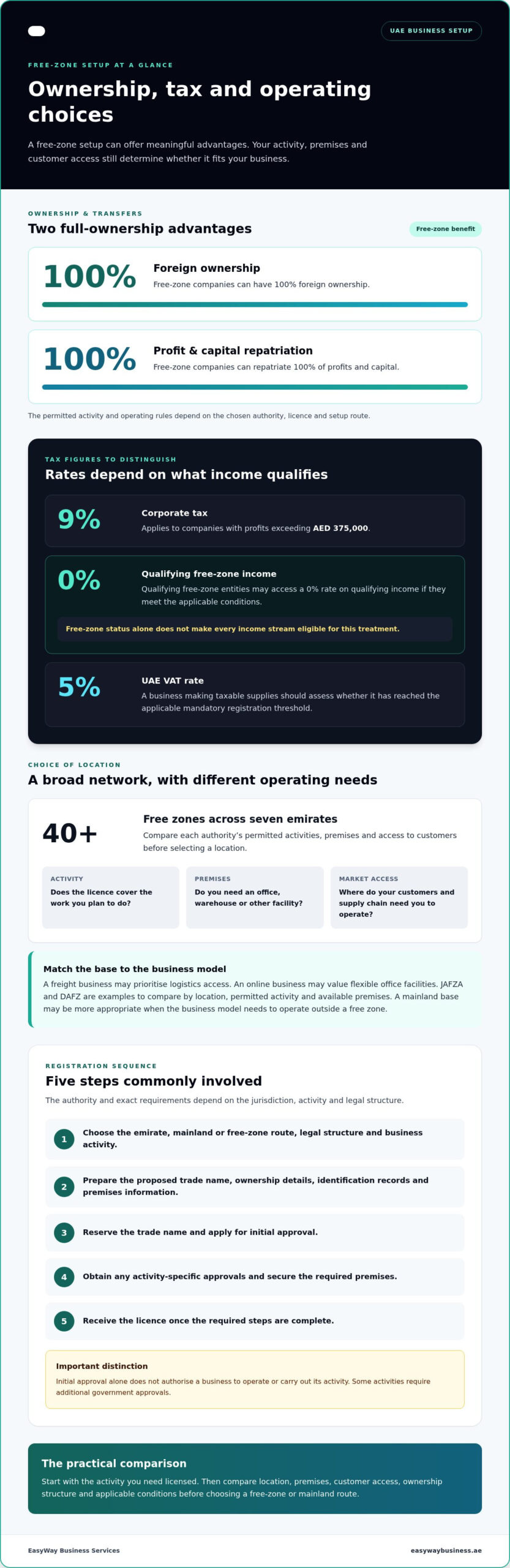
A UAE free-zone setup can give your business 100% foreign ownership and allow 100% repatriation of profits and capital. The benefits of setting up a business in the UAE also include access to free-zone options tailored to different activities. According to the Federal Tax Authority, the 9% corporate tax rate applies to companies with profits exceeding AED 375,000, applicable as of June 2023; qualifying free-zone entities may access a 0% rate on qualifying income if they meet the applicable conditions.
Those advantages matter, but the right setup depends on what your business does and where it needs to operate. A free-zone licence may suit one business model, while a mainland licence may better fit another. Because the licence and its approved activities determine what the company can do, compare the practical requirements before choosing.
This guide explains how free zones, company administration, ownership rules, profit transfers, market access and licence types affect your options. Use it to assess which UAE business setup best supports your plans and what to clarify before applying.
Key Takeaways
- Compare free-zone and mainland routes against where and how your business plans to operate.
- Map your business activity to the licence type and permissions it requires.
- Understand the administration involved in company registration and licensing before choosing a setup route.
- Assess how your business structure can support access to local, regional and overseas customers.
Table of Contents
- 1. What are the Advantages of a Company Setup in a Dubai Free Zone?
- 2. Business setup and government administration
- 3. Foreign ownership and profit repatriation
- 4. Strategic location and international market access
- 5. Business activity and licence types
- EasyWay Business Services: E-Commerce License 0 Visa
1. What are the Advantages of a Company Setup in a Dubai Free Zone?
A Dubai free zone can suit businesses seeking foreign ownership, dedicated facilities, and a defined licensing route. The UAE has more than 40 free zones across seven emirates, so compare each authority’s activities, premises, and access to customers before selecting a location.
According to the Federal Tax Authority, the UAE’s corporate tax rate is 9% for companies with profits exceeding AED 375,000, applicable as of June 2023. Qualifying free zone entities may access a 0% corporate tax rate on qualifying income if they meet the applicable conditions, according to the Federal Tax Authority. Free-zone status alone does not make every income stream eligible for that treatment.
Location affects daily operations. A company handling freight may prioritise logistics access, while an online business may value flexible office facilities. Jebel Ali Free Zone (JAFZA) and Dubai Airport Free Zone (DAFZ) are examples to compare by location, permitted activity, and available premises. Mainland locations can be more appropriate when the business model needs a base outside a free zone.
What UAE VAT applies, and when should a business register? The UAE’s VAT rate is 5%. A business making taxable supplies should assess whether it has reached the applicable mandatory registration threshold, then account for VAT on taxable sales and eligible business expenses under the rules that apply to it.
Free zones can offer office, warehouse, or other business facilities, but the required premises depend on the activity and licence. Businesses should consider what premises they need to operate. Compare facility type, location, and ongoing occupancy costs with the company’s actual operating needs before committing.
Which emirates and free zones suit different activities? All seven emirates provide company setup routes, and the UAE has more than 40 free zones. Shortlist options by the activity you need licensed, the facilities your work requires, and whether your customers or supply chain favour a free-zone or mainland base.
Free-zone companies can have 100% foreign ownership and repatriate 100% of profits and capital. Some free-zone locations also support trade and logistics operations through dedicated facilities. However, a free-zone licence defines the permitted activity, and its location may affect how the company can serve customers beyond its zone.
What visa and residency options can owners and employees pursue? A free-zone company may provide a route for owners and employees to apply for UAE residence visas. Visa allocation and eligibility depend on the setup, premises and applicable procedures, so include staffing needs when comparing options.
2. Business setup and government administration
The UAE provides digital government services and established procedures for company registration, licensing and visas. You can set up a company in any of the seven emirates, but the authority and steps depend on the jurisdiction, activity and legal structure. Map these choices first to prepare a focused application.
What steps and documents are required to set up a UAE business? Begin by choosing an emirate, mainland or free-zone route, legal structure and business activity. Prepare the proposed trade name, ownership details, identification records and premises information for the relevant authority. Additional documents or approvals may depend on the activity and jurisdiction.
Registration often involves reserving a trade name, applying for initial approval, obtaining any activity-specific approvals, securing premises and receiving the licence. Initial approval alone does not authorise a business to operate or carry out its activity. UAE trade names must end with an abbreviation of the company’s legal structure, and a company must register with the Chamber of Commerce and Industry in its emirate of incorporation.
Some activities require government approvals in addition to the company licence. An activity regulated by a specialist authority, for example, may need clearance before operations begin. Identify the exact activities early and establish which authority is responsible for each. This helps align the company’s intended work with its approved licence.
Government support also shapes the UAE’s economic environment for small businesses. The National SME Programme provides expertise, training, and technical and administrative support to SMEs. The UAE had 557,000 SMEs by mid-2022, and the country was projected to have one million SMEs by 2030. These figures show why entrepreneurs should assess both their setup route and the support relevant to their business stage.
Government tenders can provide access to public-sector work, but a licence does not secure a contract. Identify suitable opportunities, meet the stated eligibility and technical requirements, and submit a complete bid by the deadline. Keep company, ownership, financial and project records organised to prepare for bidding. Criteria vary by tender and purchasing entity.
For investors comparing mainland procedures or planning the next administrative steps, UAE company setup guidance can help clarify the route for the intended activity. Before applying, align the licence scope, required approvals, premises, and administrative records so each step supports the same operating plan.
3. Foreign ownership and profit repatriation
Ownership planning involves more than recording who invested in the company. It also clarifies decision-making, responsibilities and how returns may be handled. Before setting up a UAE business, write down each founder’s role and expectations. Use this outline to guide discussions about the legal structure and documents required for the chosen jurisdiction.
Foreign ownership rules depend on the activity and setup route. Do not assume the same arrangement applies to every licence or authority. List your planned activities and clarify how ownership conditions apply to that specific setup before finalising shareholder details or preparing incorporation documents.
Consider local sponsorship in context. Clarify whether it applies to your activity and jurisdiction rather than assuming it is required for every setup. If an arrangement involves a local sponsor or service agent, understand their role, responsibilities and relationship to the company before signing documents.
If your company has multiple founders, agree on practical decision-making procedures early. Record who can approve routine spending, sign commercial agreements and make major business decisions. Clear expectations can reduce confusion if founders disagree or someone’s involvement changes. The company’s formal documents should reflect the arrangement its owners intend to follow.
Plan how the business will manage its profits before operations begin. Distinguish funds needed for expenses and growth from amounts owners may consider distributing. Document the reasons for transfers and keep company and personal finances separate. These practices support clear financial management and help explain the company’s activity to banks and other relevant parties.
Use this preparation checklist when discussing ownership and funds:
- List each proposed shareholder and their intended role.
- Clarify activity-specific ownership conditions with the relevant authority.
- Document how founders will make and record key decisions.
- Set an internal process for reviewing profit distributions and transfers.
- Keep supporting records for business transactions and ownership changes.
Profit transfers abroad should be planned around the company’s commercial arrangements and financial processes. Before making a transfer, identify its purpose, recipient, supporting records and any contractual or banking steps involved. Keeping this information together makes cash movements easier to track and helps distinguish company earnings from personal funds.
Before choosing a structure, prepare an outline of the proposed shareholders, their roles, decision-making procedures and approach to company funds. Use it to discuss activity-specific conditions and the documentation required for your intended UAE setup.
4. Strategic location and international market access
The UAE’s location can help businesses coordinate trade between the Middle East, Africa, Asia, and Europe. The wider MENA market includes more than 450 million people, giving UAE-based companies a regional base for serving customers. Market access still depends on your business activity, licence, customer location, and operating structure.
Dubai’s transport infrastructure supports businesses moving people, products, or both. Jebel Ali Port handles about 14 million TEUs annually, a useful consideration for importers, exporters, and logistics companies. Dubai International Airport connects to 256 destinations in 102 countries, supporting international travel and time-sensitive business coordination.
Let your supply chain inform location decisions. A company moving freight may prioritise access to port facilities and warehouse space. A consultancy serving overseas clients may value airport connections and accessible offices. Compare locations against the daily needs of your operations, not just their profile.
Regional reach is not automatic. A UAE company’s ability to serve overseas clients, regional companies and local customers depends on its structure and activity. Before choosing a setup, map your target markets, delivery method and customer needs. Then confirm that the proposed licence and operating arrangements support those activities.
Talent is another part of market access. More than 200 nationalities live and work in the UAE, creating a diverse workforce environment for companies recruiting across different backgrounds. For a business planning to hire, define the roles, skills, and language needs first. Then consider how the location and office setup support recruitment and daily work.
Infrastructure planning also shapes business decisions. The UAE’s 2024 infrastructure programme covers 127 projects through 2029. For an investor, this provides context for evaluating transport and connectivity, not a guarantee of a particular commercial result. Consider how relevant projects relate to your supply chain and customer base.
Regulatory fit matters as much as geography. A company’s licence, permitted activity and jurisdiction affect how it can serve customers. Review these factors before committing to premises or planning cross-border operations. A logistics firm and a digital consultancy, for example, may need different facilities and regulatory arrangements even if both target international clients.
To assess whether a UAE location suits your business, list your main customer markets, suppliers, staffing needs and transport requirements. Match each need to a practical location and operating plan. This helps you weigh infrastructure, office space and market access against the work your company will actually do.
5. Business activity and licence types
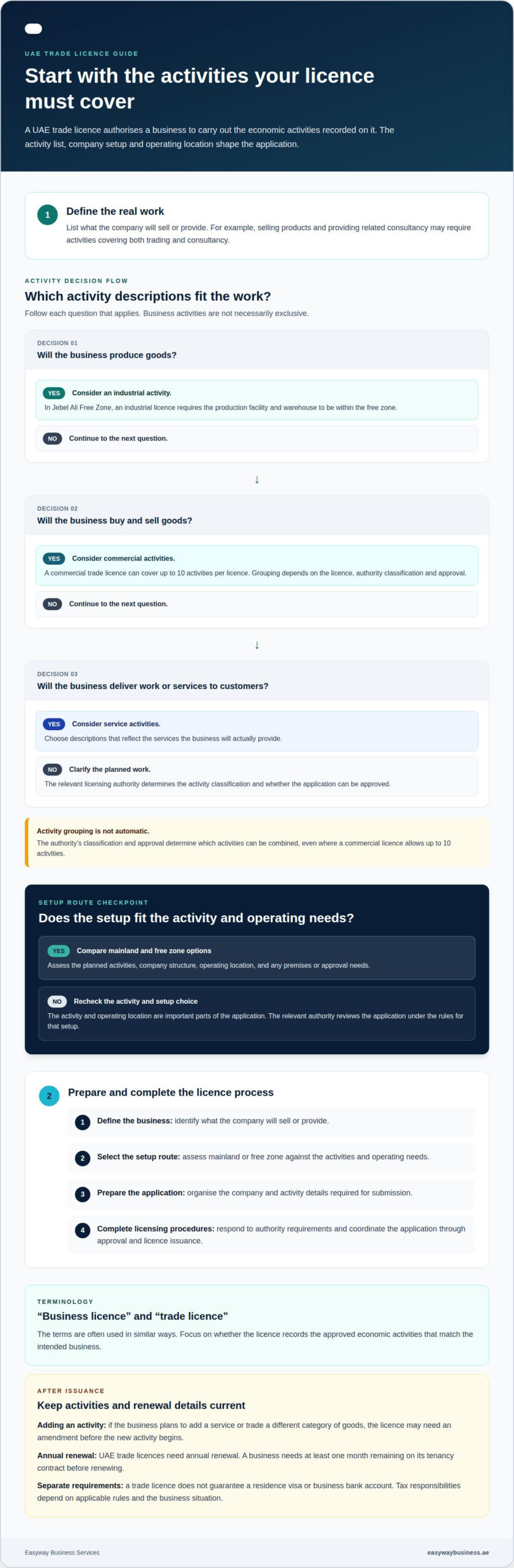
Your business activity should guide your licence choice, not the other way around. The UAE has more than 2,000 economic activities, so entrepreneurs need to define what the company will actually do. For example, selling products online differs from providing consultancy, even if both businesses operate digitally.
A licence sets out the activities a company is permitted to carry out. Describe your core service or product in plain language, then match it to the activity wording used by the licensing authority. A broad business plan is not a substitute for accurate activity selection.
Consider a company planning to sell products and offer paid advice. These are distinct revenue activities, so identify both before applying. The authority’s approved activity scope determines what the company may do. If the application covers only product sales, later consultancy work may fall outside the original licence scope.
The setup route determines which licensing process applies. A free-zone authority issues licences within its zone, while a mainland company follows the relevant emirate’s process. The right route depends on the activity and intended customers. Compare permitted activities, premises options and operating conditions before choosing.
Licence names can suggest a commercial purpose, but the approved activities matter more than the label. A commercial licence may relate to trading, while a service business needs activities that describe the services it provides. Check each planned revenue stream against the approved scope, including secondary services and sales channels.
Use this activity-matching process before submitting an application:
- Write down each product or service the company plans to sell.
- Separate distinct revenue activities, such as retail sales and consulting.
- Match each activity to the licensing authority’s approved wording.
- Compare the resulting scope with the company’s planned operating route.
This framework can prevent a mismatch between the business plan and its licence. The UAE Commercial Companies Law is Federal Decree-Law No. 32 of 2021. For entrepreneurs, the practical task is to ensure the chosen legal structure, licence scope, and actual operations align.
Activity selection can influence decisions about premises, staffing and customer access. A trading company may need facilities for handling products, while a consultant may prioritise suitable office space. Define these needs alongside the activity list, then compare the options offered by the relevant authority.
Before you settle on a licence route, discuss your planned business activities and how they fit your setup choices. Clear activity wording gives your application a practical foundation and helps you understand what your company is authorised to do.
EasyWay Business Services: E-Commerce License 0 Visa
EasyWay Business Services helps you compare UAE company setup options and understand the steps involved in licensing. If your business plan centres on online sales, the E-Commerce License 0 Visa may fit your starting point. For other needs, options include a Freezone license with one visa, a Freezone license with Two visa, or a Dubai Mainland commercial License.
Start by identifying your planned activity, preferred jurisdiction and staffing needs. EasyWay Business Services can guide you through UAE company formation and help compare the available options. Recommendations depend on your circumstances, and requirements and approvals are set by the relevant authority.
To discuss a setup route for your business, contact EasyWay Business Services or visit easywaybusiness.ae.
Turn your UAE business plan into a clear next step
The benefits of setting up a business in the UAE become practical when your company structure matches its activities, customers and operating plans. Before moving forward, write down what you will sell, who you will serve and whether you need a free-zone or mainland setup. These priorities help you discuss suitable licences and prepare for the relevant formation procedures.
EasyWay Business Services offers an E-Commerce License 0 Visa, a Freezone license with one visa, and a Freezone license with Two visa. If you’re ready to explore which setup aligns with your plans, speak with the team about your intended activity and preferred route. Your next step can be a focused conversation, not a commitment to a particular structure.
Contact EasyWay Business Services to discuss your UAE company setup. Take the first step with a clearer plan and move forward at your own pace.
Frequently Asked Questions
What are the advantages of a company setup in a Dubai free zone?
A free-zone setup may suit a business seeking a licence and operating environment aligned with a particular sector. Compare the authority’s activity list with your products or services, then assess whether its facilities suit your workflow. A company storing goods, for example, should consider warehouse access, while a service business may prioritise suitable office arrangements. Practical fit matters more than a zone’s name.
What are the pros and cons of free-zone company setup in Dubai?
A defined authority and setup framework can make company formation more straightforward. However, the chosen licence and jurisdiction may not cover every planned activity or customer arrangement. Before applying, list your revenue streams, suppliers and customer types, then compare them with the authority’s activity scope and operating conditions. This can reveal gaps before they affect contracts, invoicing or expansion plans.
Why should you set up your business in the UAE?
The UAE may suit entrepreneurs with a clearly defined customer base and operating plan. Identify whether your first customers will be local, regional or overseas, then consider how you will deliver and support your product or service. This turns a broad relocation decision into a business case and helps you decide which capability to establish first, such as sales, fulfilment or professional services.
What are the main benefits of setting up a business in the UAE?
Potential advantages include choosing a structure that reflects your ownership plan, selecting activities that match your offer and placing operations near relevant customers or suppliers. The value depends on how well the setup fits your business, not simply on registering a company. If you plan to offer several related services, clarify whether the licence covers each one. A clear activity and customer plan makes the decision more practical.
What are the UAE corporate tax rates and exemptions for mainland and free-zone companies?
Tax treatment depends on taxable income, company activities and whether a free-zone entity meets the conditions for qualifying treatment. A free-zone location alone does not determine the tax outcome. Before choosing a structure, document expected revenue sources and transactions, then seek advice based on those details. This gives an adviser a practical basis for assessing how the rules may apply.
What are the costs of starting and renewing a UAE business licence?
Budget for more than the licence application. Consider the jurisdiction, activity scope, premises, visa needs and any relevant approvals or documentation. Account for recurring licence and facility requirements when planning renewals. Ask for a current itemised quotation separating authority charges from service costs, and compare renewal terms before choosing a setup.
What is the difference between UAE mainland and free-zone company setup?
The main differences are the registering authority, licensing framework and operating conditions for each route. Compare them against your planned activities, customer types, premises needs and any sector approvals. A company planning to add a service later, for example, should understand how its authority handles activity changes rather than focusing only on initial registration.
Can foreign investors own 100% of a UAE company, and what exceptions apply?
Foreign investors can hold full ownership in many UAE activities, but the applicable conditions depend on the activity and company structure. Before naming shareholders, confirm the rules for the intended licence scope and jurisdiction. Prepare clear shareholder information and agree how decisions, responsibilities and ownership changes will be documented. This helps align ownership records with planned operations instead of relying on assumptions about local sponsorship.
Article by
Nasser Janzal
Nasser Janzal is a Co-Founder and Chief Executive Officer with more than 10 years of experience in business development, sales, operations, and strategic leadership. Based in the UAE, he specializes in business setup, company formation, corporate structuring, and growth strategy across Dubai and the wider UAE.
Through his work with entrepreneurs, investors, startups, and established companies, Nasser has developed extensive practical knowledge of UAE Free Zone and Mainland company formation. He is passionate about helping business owners understand the UAE market, make informed decisions, and build strong foundations for sustainable growth.
Through his articles, Nasser shares practical insights on starting and growing a business in the UAE, company formation, entrepreneurship, business strategy, and navigating the UAE's evolving business environment.